Road Trip Through 5 of America’s Most Haunted Cities
From Poe’s Baltimore to witch-trial-era Salem, discover ghostly hotels, notorious prisons, buried secrets, and centuries-old legends along the way


As the Halloween season creeps in, there’s no spookier time to travel through some of America’s earliest cities and settlements, discovering the haunting tales that have followed them through the centuries. From historic taverns and former prisons to legendary landmarks and storied hotels, this five-city road trip explores centuries of American history—and the ghost stories left behind.
Baltimore
Start your journey in the historic port city of Baltimore. Founded in 1729, this cobblestone and waterfront beauty is equally rich in nautical history and literary culture. Here in this city once condemned as a “nest of pirates” by the British military, one can’t help but imagine the evolution of tavern life throughout the decades, from sailors swapping mysterious tales of the sea to literary legends such as F. Scott Fitzgerald and Edgar Allan Poe finding inspiration for their next great works.
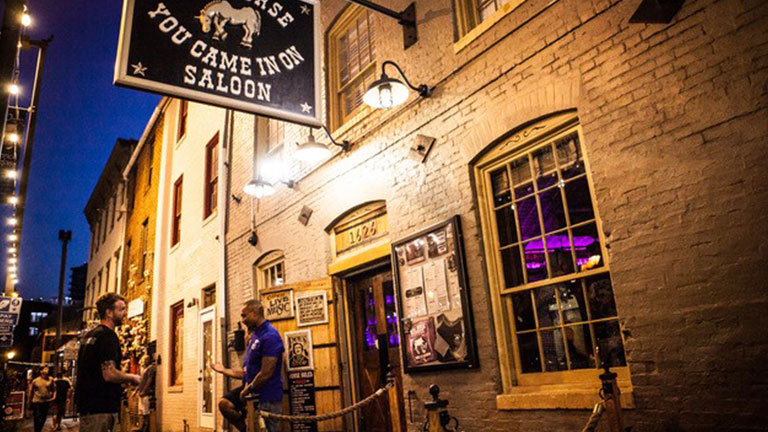
Haunted travel stop: The Horse You Came In On Saloon
A spot that weaves together Baltimore’s nautical history, literary legacy, and a few ghost stories is The Horse You Came In On Saloon in the Fell’s Point neighborhood. Locally known as “The Horse,” the colonial-era building has operated as a bar or saloon since 1775, even serving patrons through Prohibition.
Legend has it that horror writer Edgar Allan Poe frequented the tavern and that it was one of his final stops before his death in 1849. Although there is no historical proof that Poe had his last drink at The Horse, it has become part of the saloon’s lore.
Staff members have reported strange occurrences in the bar that they believe to be from Poe’s spirit, including cash registers flying open and chandeliers swinging without reason. It’s even been reported that they’ll leave a glass of whiskey out for him at closing time.
Today, a “Poe’s Last Stop” sign inside the saloon keeps the legend alive, making The Horse a fitting place to raise a glass to Baltimore’s literary past and perhaps one of its lingering spirits.
Baltimore’s haunted hotel: Lord Baltimore Hotel
If you dare to continue your haunting adventures into the night, a stay at the historic Lord Baltimore Hotel awaits. Opened in 1928, the grand downtown hotel was once among the tallest buildings in the city. During the Great Depression, there were at least 20 documented reports of people falling or jumping from the hotel’s rooftop deck.
Much of the hotel’s haunted lore centers on the 19th floor, with the hotel’s elevator known to randomly ride to this floor, but when the doors open, nobody’s there. Its most famous ghost story, however, involves a young girl known as Molly, who is said to wander the halls in a white dress, sometimes accompanied by a red ball. Legend says she was the daughter of parents who committed suicide during the Great Depression by jumping from the hotel, taking her along for the deadly plummet. Guests and staff have also reported unexplained footsteps and the feeling of unseen presences.
The hotel doesn’t shy away from its spooky reputation. Paranormal investigations and ghost tours have been held on the property, and the Lord Baltimore currently offers a Ghost & Glamour package that pairs an overnight stay with tickets to Poe’s Magic Theatre and a ghost tour through the hotel.
The Lord Baltimore Hotel offers an apropos place to spend your first night on the road if you want to continue the thrills and chills deep into the night. Just don’t be surprised if the elevator decides which floor you’re visiting.
Philadelphia
After a night in Baltimore, head north to its city cousin: Philadelphia. Founded in 1682, the City of Brotherly Love played a starring role in the birth of the nation, with historic landmarks such as Independence Hall and the Liberty Bell serving as reminders of its Revolutionary past.
But with centuries of history also come centuries of ghost stories. Tales of lingering spirits surround some of the city’s most historic places, from Independence Hall to Fort Mifflin, the site of one of the most intense battles of the American Revolution.
Philadelphia also offers another connection to the literary legend we left behind in Baltimore. Edgar Allan Poe called the city home for six years, from 1838 to 1844. Today, the only one of his Philadelphia residences still standing is preserved as the Edgar Allan Poe National Historic Site, offering another glimpse into the life and imagination of the master of the macabre.
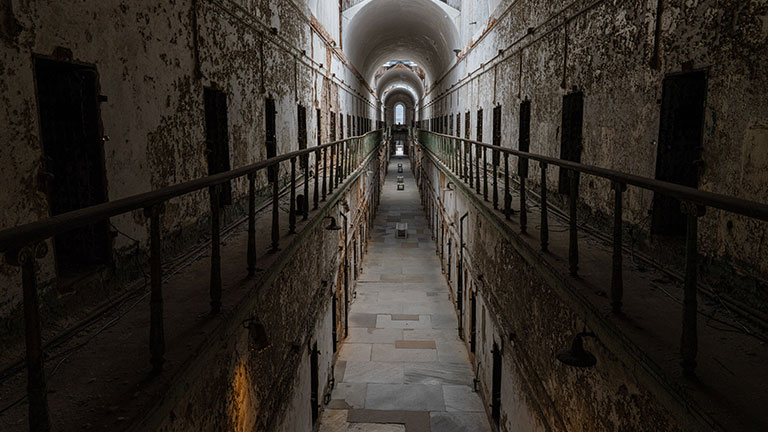
Haunted travel stop: Eastern State Penitentiary
Philadelphia is known for quite a few firsts, including what many consider to be the country’s first true penitentiary: Eastern State Penitentiary. When it opened in 1829, the imposing prison introduced a radical approach to incarceration built around isolation. Prisoners spent nearly all of their time alone in individual cells, a system intended to inspire reflection, penitence, and—ultimately—reform.
The experiment gained international attention, but not everyone was convinced. Charles Dickens visited Eastern State in 1842 and later condemned the psychological effects of its system of solitary confinement. Over its 142 years as a prison, Eastern State housed tens of thousands of people, including notorious gangster Al Capone, before closing in 1971.
Today, its abandoned cellblocks, peeling walls, and empty guard towers make the National Historic Landmark an eerie place to explore even without any ghost stories. Visitors, staff, and paranormal investigators have reported unexplained footsteps, voices, shadowy figures, and other strange activity throughout the prison.
Come Halloween season, the atmosphere gets even darker. Eastern State transforms after hours for Halloween Nights, filling portions of the former prison with haunted attractions, immersive experiences, and entertainment. Travelers who would rather experience history without actors jumping out of the shadows can tour the penitentiary during the day.
Whether you visit for the documented history or the stories of what may still linger behind its walls, Eastern State proves that sometimes the most unsettling haunted places are the ones with very real stories to tell.
Philadelphia’s haunted hotel: The Bellevue Hotel
After spending hours in a haunted prison, treat yourself to a night of luxury at The Bellevue Hotel. Originally opened as the Bellevue-Stratford in 1904, the lavish hotel earned the nickname “Grande Dame of Broad Street” and became a gathering place for presidents, royalty, and Philadelphia high society.
After about three years of restoration between 2021 and 2024, the hotel is a stunning AAA Four Diamond property. Still, decades of hauntings and eerie experiences may be lingering within its gorgeous interiors.
Guests have reported unsettling encounters that are difficult to explain. Some describe sudden temperature drops in the middle of the night. Others have felt an unseen hand tugging at their covers—or even pulling gently at their toes beneath the sheets. For some guests, there’s an immediate uneasiness as soon as they enter their rooms.
Just make it through the night—and then indulge in an opulent breakfast at Pergola, which offers sweeping city views on the hotel’s 19th floor.
New York City
Next up: big scares in the Big Apple. Hear tales of unexplained activity at the Merchant’s House Museum or the Morris-Jumel Mansion, Manhattan’s oldest surviving residence. Both have their distinct collection of ghostly legends.
Edgar Allan Poe’s legacy stretches into New York, too. He lived in the city during several periods of his life, and his final New York home still stands in the Bronx as the Edgar Allan Poe Cottage.
Haunted travel stop: Washington Square Park
With so many spooky stops to choose from in NYC, one you can’t miss is Washington Square Park. Today, Washington Square Park is a gathering place known for its iconic arch, street performers, musicians, and people-watching. But beneath all that activity lies a much darker piece of New York history.
Long before it became a public park, portions of the land served as a burial ground. Beginning in the late 18th century, thousands of early New Yorkers were buried here, including victims of yellow fever and those who could not afford private burials. Although the cemetery eventually closed and the land was transformed into Washington Square, many of those remains were never removed. In fact, human remains have occasionally been uncovered during construction projects around the park.
Visitors have reported shadowy figures, unexplained sounds, and other eerie encounters around the park after dark. One of its most enduring ghost tales involves Hangman’s Elm, an enormous English elm in the park’s northwest corner. It’s Manhattan’s oldest known tree at more than 300 years old. Legend says criminals and traitors during the American Revolution were hanged from the tree and that it’s haunted by the ghosts of those executed.
NYC’s haunted hotel: Hotel Chelsea
If a visit to Washington Square was a walk in the park, take your chances spending the night at The Hotel Chelsea.
Built in 1884 and later converted into a hotel, the landmark has attracted generations of writers, musicians, and artists. Mark Twain, Bob Dylan, Patti Smith, Janis Joplin, Leonard Cohen, and Arthur Miller are just a few of the famous names connected to its storied halls.
A stay at The Hotel Chelsea comes with a legacy of famous history—but also a deeply painful one. It’s the place where Welsh poet Dylan Thomas fell into a coma before dying, and where Nancy Spungen, the American girlfriend of Sex Pistols bassist Sid Vicious, was found stabbed to death.
Over the years, guests and visitors have reported ghostly encounters believed to be connected to the hotel’s past, former residents and tragic figures who lost their lives within its walls. One of its most heartbreaking ghost tales involves a woman known as Mary, who, according to legend, survived the sinking of the Titanic but lost her husband in the tragedy. She fell into depression and took her own life, and she now allegedly haunts the hotel.
Boston and Salem, Massachusetts
Our final stop lands us in Massachusetts for not one but two haunted destinations: Boston and Salem.
In Boston, centuries-old burial grounds, historic taverns, and landmarks tied to the American Revolution make it easy to explore the city’s past, while places like the Granary Burying Ground—the final resting place of Paul Revere, Samuel Adams, John Hancock, and other Revolutionary-era figures—and Boston Common—where public executions, including hangings, once took place—have inspired their share of haunted tales. Boston is also the birthplace of Edgar Allan Poe.
About 30 minutes north of Boston is the coastal city of Salem, a setting synonymous with the infamous Salem Witch Trials of 1692–1693. During that dark time, more than 200 people were accused of witchcraft, and 20 were executed.
The city has transformed its complicated past into a destination filled with museums, historic homes, walking tours, and, naturally, plenty of ghost stories. It gets very crowded during Halloween season, so it’s essential to plan well in advance if you’ll be visiting Salem in October.
Salem may embrace its spooky reputation, but the real events behind it were far more tragic. Innocent people were persecuted and killed, making this a place where it’s especially important to separate the documented history from centuries of legend.
Haunted travel stop: The Witch House
No haunted journey through Salem is complete without a visit to The Witch House, one of the few structures still standing in Salem with a direct tie to the Salem Witch Trials. The dark, steep-roofed home once belonged to Jonathan Corwin, one of the magistrates involved in the proceedings that resulted in the executions.
Today, visitors can step inside the 17th-century home to learn about Corwin and his family while exploring what everyday life was like in colonial New England. Exhibits also provide a deeper look at the beliefs, fears, and social tensions that contributed to the witch trials, offering an important reminder that Salem’s darkest chapter was not a ghost story, but a very real tragedy.
Of course, a centuries-old home connected to one of the most infamous events in American history comes with its share of paranormal tales. Visitors have reported unexplained sounds, cold spots, and the feeling that they aren’t entirely alone. Whether you experience anything unusual or not, walking through the rooms where someone directly involved in the trials once lived is haunting enough on its own.
Salem’s haunted hotel: Hawthorne Hotel
For your final haunted overnight, check into Salem’s historic Hawthorne Hotel, which has been welcoming guests since 1925. Located in the heart of downtown Salem, the grand hotel is named for Salem-born author Nathaniel Hawthorne, whose own family history has an interesting connection to the witch trials: His ancestor John Hathorne was one of the magistrates involved in the 1692 proceedings.
A century of guests has also given the Hawthorne its share of ghost stories. Visitors have reported unexplained sounds, strange sensations, moving furniture, and sightings of a ghostly woman, with some of the hotel’s best-known tales surrounding Room 325 and the sixth floor. The hotel has even hosted a séance in its Grand Ballroom in an attempt to contact magician Harry Houdini, and in 2007, the paranormal TV series Ghost Hunters came to investigate.
…..
From Baltimore’s historic waterfront and Philadelphia’s prison walls to the buried past beneath New York City and the sobering history of Salem, each stop reminds us that history doesn’t simply disappear with time. It survives in landmarks, legends, and the stories passed from one generation to the next.
Whether you believe in ghosts or simply enjoy a good mystery, exploring the darker side of America’s past can reveal just how much history is still lingering all around us.