How to Spot and Avoid Online Scams: Protecting Yourself from Modern Fraud
From AI voice cloning to fake police calls, learn how to recognize sophisticated scams and protect your personal information and money



Jill Matthews and her husband were in their car when her cell phone rang. “It was a police officer who told me that I had failed to appear as a witness in a federal case,” recalls the Lewes, Delaware, resident. “I didn’t know what he was talking about.” Matthews was one of several customers who’d paid for—but never received—furniture from a nearby Rehoboth Beach store. Was that the case?
Although the officer declined to offer details, he told her his badge number, name and the names of his superior and the judge. He also correctly identified her home address. She had three choices: Turn herself in, call a lawyer or purchase a bond.
She wanted to call him back, but the officer warned her to stay on the line.
She decided to drive straight to the police station, but when she told him that she’d arrived there, he hung up.
“My adrenaline was through the roof,” she says. “I’m thinking I might be arrested.” The front desk officer reassured her. All the names were real, but it was a scam; the caller had banked on Matthews’ desire to avoid the police and pay the bond.
“If you receive a call like this, hang up, look up the official nonemergency number, and call the police department directly to verify the call’s authenticity,” says Stephen Boyce, founder of The Cyber Doctor, a Washington, DC-area cybersecurity firm. “Scammers count on panic, so slowing them down is your best defense.”
The story illustrates the increasing sophistication of scams. Recognizing the signs can help consumers protect themselves.

“Phishing” for information
In 2024, consumers lost more than $12.5 billion to fraud, a 25 percent increase over 2023, according to the Federal Trade Commission. Adults over 60 suffered the most, losing nearly $5 billion, according to the FBI. Scammers target older adults because they’re often polite and trusting. They have more savings and may be less technologically savvy than younger adults.
Common scams include texts or emails regarding missed deliveries, especially around the holidays, and overdue invoices. Many scams impersonate well-known brands such as the Geek Squad, Google, Microsoft and Apple.
“Many people trust [the brand] and do the wrong thing, which is click the link or attachment that loads malware on their computer or steals their identity,” says Eric O’Neill, a former FBI counterintelligence operative and founder of The Georgetown Group in Washington, DC, which lists cybersecurity among its offerings.
Some emails contain a QR code—a black-and-white box. Clicking it will give the scammer access to your computer or phone. Scammers may also have professional-sounding call centers. Regardless, there is always a sense of urgency: act now or face consequences.

The personal touch
Scammers also exploit relationships. Suzanne O’Connor Lenhard, owner of Calm Care Navigation & Private Nursing Service in Delaware, says her 85-year-old client received a call from what appeared to be Lenhard’s number. The caller said that Lenhard had been arrested for drunk driving and needed bail money. Fortunately, the client hung up.
Dating apps and social media are other methods scammers use to part you and your money. In 2024, the FTC reported that victims lost $823 million across these platforms. Scammers use fake names and AI-generated profiles to capture someone’s interest and build trust over time. Ultimately, there’s an urgent plea for money. The scammer may also suggest a cryptocurrency investment, a scheme that also unfolds over months.
O’Neill says clever scammers scour social media, examining profiles and using AI to craft an email or text that will resonate with a person. “AI is changing the game for them,” he says.
For instance, AI voice cloning can mimic a trusted person’s voice.
“The sophistication of recent AI deepfake impersonations is a clear and alarming demonstration of how cybercriminals are weaponizing AI to erode trust at every level of society,” says Steve Grobman, chief technology officer at McAfee, an online protection company. “Once they’ve established a false sense of familiarity, they claim there’s a crisis, a deadline or a threat to push victims into acting without thinking.”

Voices of authority
Criminals also impersonate trusted figures, such as police officers, federal employees or bankers. New York Times crimes reporter Michael Wilson received a call informing him that someone had opened a Chase Bank account in his name and transferred $2,100 via Zelle, a peer-to-peer payment app. The caller ID belonged to a Chase office. More than 15 minutes later, and while following the caller’s online instructions, Wilson suggested resolving the matter in person and hung up. He called his bank: There had been no recent Zelle activity.
Darius Kingsley, head of Chase’s consumer banking practices, would approve. “If you get a call or text from someone claiming to be your bank, pause and take a breath, hang up, then call the number on the back of your debit card to verify if the call is legitimate.”
As scammers become ever more sophisticated, it’s important to stay cautious and be proactive to avoid becoming a victim.
How to protect yourself
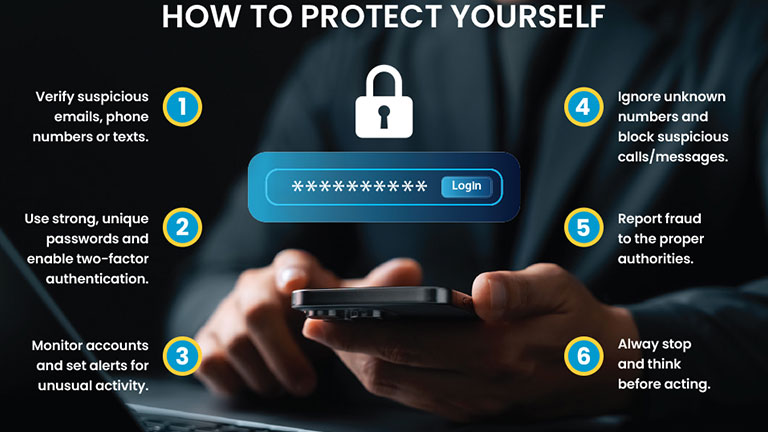
- Verify suspicious emails, phone numbers or texts.
- Use strong, unique passwords and enable two-factor authentication.
- Monitor accounts and set alerts for unusual activity.
- Ignore unknown numbers and block suspicious calls/messages.
- Report fraud to authorities.
- Always stop and think before acting.